
Quirón Hospital.
Av. Imperio Argentina 21, Malaga
Monday - Thursday
from 10 to 2 pm and from 4 pm to 8 pm
Friday
from 10 to 2 pm
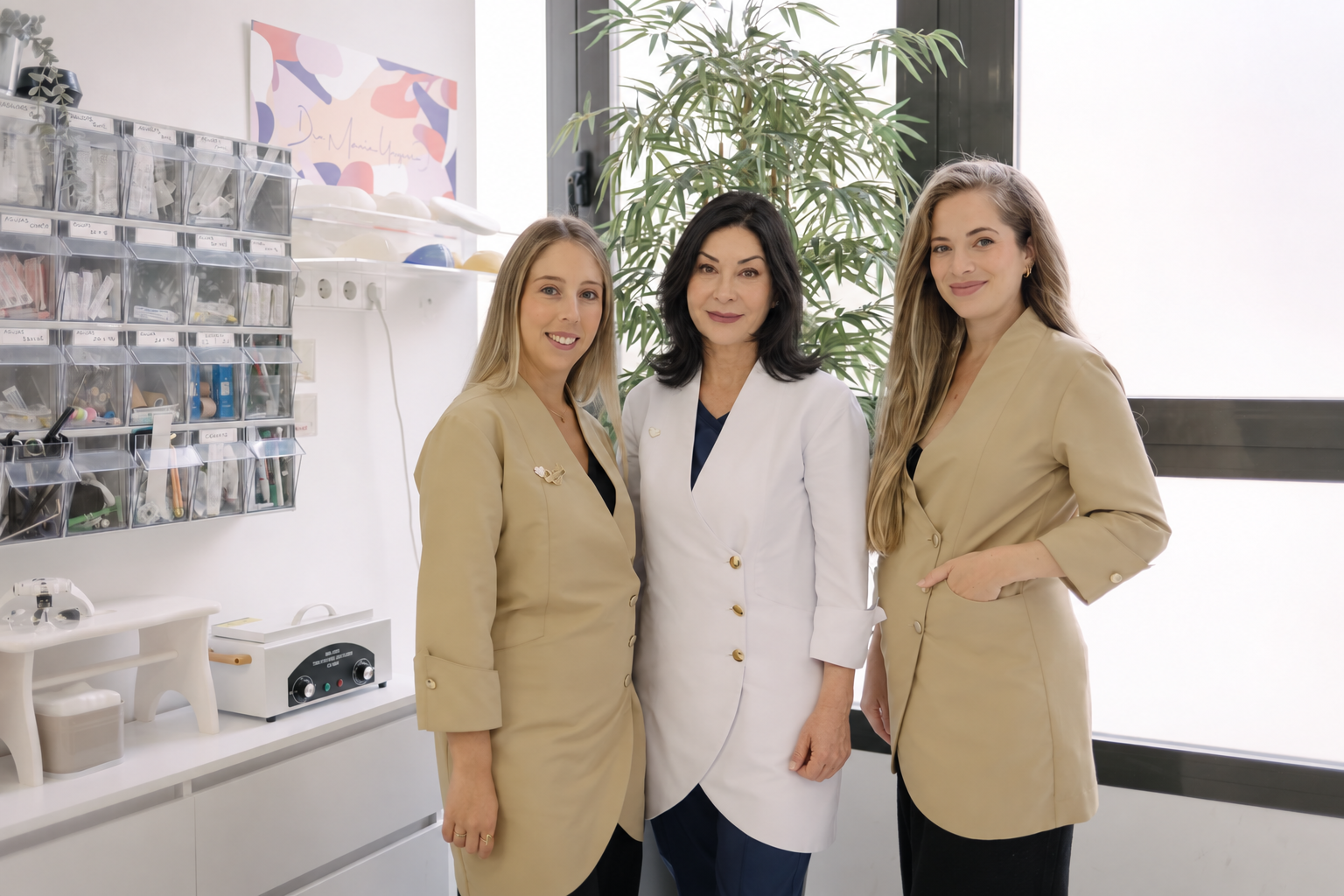
Actualizado el 01/10/2026 · Dra. María Lourdes Yagües, cirujana plástica
Lipedema is a progressive disease of the fat tissue that affects almost exclusively women. It is characterised by an abnormal, disproportionate build-up of fat, mainly in the arms and legs.
The key thing to understand is that lipedema is classified in two different ways: by stage (three levels that describe how the tissue has changed) and by type (categories that describe which part of the body is affected). They are not the same thing, and they are constantly confused.
What stage is your lipedema at?
Dr. Yagües specialises in the diagnosis and surgical treatment of lipedema. Get your mobility and your comfort back with a plan built around your case.
The diagnosis has to be made by a specialist. That said, these are the symptoms that will tell you whether it is worth having yourself assessed.
Seen mainly in the legs (around 97% of cases). It is usually bilateral and almost symmetrical, on both legs or both arms. The hands and feet are typically spared, which produces the characteristic cut-off at the ankle or wrist.
A constant feeling of pressure and heaviness in the legs that does not improve by raising them or with localised massage.
Red, purple or blue marks on the surface of the skin caused by dilated capillaries.
The skin of the legs and arms feels hard because of the fatty nodules underneath.
It is common to feel pain on contact: when someone leans on your legs or takes you by the arm.
The tissue becomes stiffer, and bending the knee or the ankle can become difficult.
Discomfort that becomes more marked over time. It is spontaneous, it can be present at rest, and it usually increases with physical exercise.
These appear at the more advanced stages. The most common are hyperpigmentation and dermatosclerosis, where the skin hardens.
You may have relatives with the same picture, including on your father’s side.
The stages describe the structure of the tissue and the texture of the skin:
The types are defined by which areas of the body are affected:
Treatment should be directed by a specialist. If the assessment confirms lipedema, there are two routes:
It helps reduce some of the symptoms. It combines manual lymphatic drainage with therapies that reduce fibrosis and improve fluid movement through the skin. Compression garments and exercise in water are also recommended.
Water-jet assisted liposuction (WAL). The pressurised water detaches the diseased fat while protecting the lymphatic vessels and nodes during surgery, which is precisely what a conventional liposuction cannot guarantee.
Dr. María Lourdes Yagües assesses and operates on lipedema personally at her clinic in Málaga. Consultations are available in English.
What stage of lipedema are you at?
The stages look very similar in photographs, but the treatment changes considerably from one to the next. In consultation your stage is established and you are told what your real options are.
Message us on WhatsAppBook a consultation
Dra. María Lourdes Yagües · Plastic, Aesthetic and Reconstructive Surgery · Málaga
More information: Lipedema treatment in Malaga
Take the 1-minute test. Dr. Yagües reviews every case personally and replies within 24 hours.
Stage 1 — smooth skin, pain on pressure, the stage nobody diagnoses
Stage 3 — visible lumps, rubbing and when to operate
Stage 4 — when lymphoedema is added
Medically reviewed by Dr. María Lourdes Yagües Giménez, plastic surgeon (medical licence no. 085043341), member of SECPRE and AECEP. Hospital Quirónsalud Málaga. · Updated 01/10/2026
Otros artículos
